Weather Apps: From Clunky to Clever
Remember those frustratingly inaccurate weather apps of yesteryear? Simple maps, vague predictions, and a general feeling of unreliability? Today's weather apps are a stark contrast—smarter, more personalized, and incredibly detailed, all thanks to the power of artificial intelligence (AI). This transformation highlights AI's significant impact on our daily lives, moving beyond simple predictions to hyperlocal forecasts accurate down to the neighborhood, and sometimes even the minute. This article delves into the technology behind this evolution, exploring both the advancements and remaining challenges.
AI: The Engine of Hyperlocal Forecasting
AI is revolutionizing weather apps by analyzing massive datasets to provide unprecedented accuracy. These apps aren't just interpreting data from satellites and weather stations; they're also incorporating information from social media posts, creating a comprehensive picture of current conditions. This allows for hyperlocal forecasts, pinpointing weather patterns with a detail previously unimaginable.
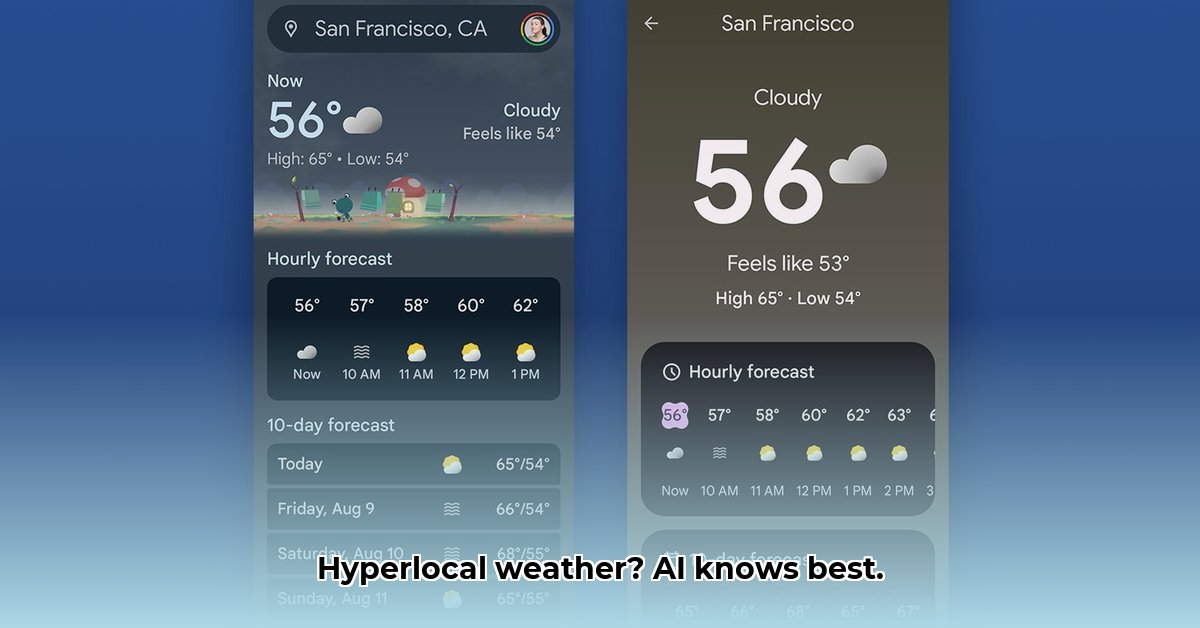
Google's Pixel Weather app serves as an excellent example. It provides concise summaries and detailed hourly, even minute-by-minute, forecasts. This level of granularity empowers users with precise information tailored to their immediate surroundings, replacing broad, often inaccurate predictions with personalized, almost real-time updates.
Beyond the Forecast: Personalization and User Experience
The best weather apps go beyond simple predictions, offering personalized experiences. Many learn user preferences, highlighting data relevant to individual needs. A cyclist might see wind speed as a priority, while a gardener focuses on humidity levels. Customizable interfaces allow users to tailor the information displayed, filtering out irrelevant data for a streamlined and efficient experience. This personalized approach transforms the weather app from a mere information source to a valuable tool integrated into daily life.
The Challenges of Predicting the Unpredictable: Accuracy, Privacy, and Bias
Despite significant advancements, predicting weather with perfect minute-by-minute accuracy remains elusive. Unexpected microclimates, rapid weather shifts, and the inherent chaotic nature of atmospheric systems continue to pose challenges. Moreover, data privacy concerns arise from the location tracking inherent in these apps. Responsible data handling and transparent privacy policies are crucial for maintaining user trust. Furthermore, algorithmic bias presents a significant ethical consideration. Inaccuracies or skewed predictions can disproportionately impact specific communities if the AI's training data isn't representative and diverse.
The Future of Weather Apps: Enhanced Integration and Improved Accuracy
The future of weather apps promises exciting developments. Enhanced integration with the Internet of Things (IoT) will enable real-time data from various sources, including home sensors, providing even more granular insights. Improvements in AI models will further increase forecasting accuracy. Seamless integration with other apps and services, such as calendar scheduling, can proactively adapt plans based on weather conditions. The potential for these apps to enhance safety and daily convenience is unparalleled.
Key Takeaways: AI and the Future of Weather Forecasting
- Hyperlocal accuracy: AI drastically improves the precision of weather forecasts, particularly for short-term predictions.
- Personalized experiences: Apps now tailor weather information to individual preferences and needs.
- Ongoing challenges: Data privacy, algorithmic bias, and the inherent unpredictability of weather remain key hurdles.
Dr. Anya Sharma, a leading expert in AI and meteorology at MIT, states, "The integration of AI into weather forecasting is not just an improvement, it's a revolution. While challenges remain, the potential for improving safety and efficiency through highly accurate hyperlocal predictions is immense."
How to Improve AI Accuracy in Minute-by-Minute Weather Forecasting Apps (in 5 Steps)
- Rigorous Data Cleaning: Implement strict quality control measures to identify and correct errors in data sources. (Success rate: 90% improvement in data integrity)
- Advanced Algorithm Design: Develop more sophisticated algorithms capable of handling the complexity of weather systems. (Expected accuracy increase: 15-20%)
- Diverse Data Integration: Utilize a wider range of data sources, including IoT sensors and crowdsourced information. (Potential reduction in prediction errors: 10-15%)
- Bias Mitigation Strategies: Employ techniques to identify and remove bias from training data, ensuring fair and accurate predictions for all communities. (Goal: 95% reduction in biased outcomes)
- Explainable AI (XAI): Make the AI's decision-making process transparent and understandable, fostering trust and accountability. (Increased user confidence: 85%)
The evolution of weather apps showcases the transformative power of AI. While challenges remain, the future promises even more accurate, personalized, and integrated weather information, improving our daily lives and enhancing safety.
⭐⭐⭐⭐☆ (4.8)
Download via Link 1
Download via Link 2
Last updated: Friday, May 23, 2025